Trace the transition of jute folders from rustic agricultural storage to high-end executive desk accessories in the modern, eco-conscious office.
The layout of the corporate workspace has undergone immense structural transformation over the last few decades. From the paper-heavy, cubicle-dense offices of the late 20th century to the minimalist, tech-driven, and health-conscious environments of today, our tools inevitably reflect our cultural values.
Among these tools, the systems we use to hold our most critical physical assets—document folders—have quietly undergone a remarkable evolution. Once dominated by synthetic polymers, the modern executive desk is increasingly playing host to a natural phenomenon: The Jute Folder.
The journey of jute from a rugged agricultural commodity to a symbol of contemporary eco-luxury is a masterclass in how industrial design can adapt to meet the demands of a changing planet.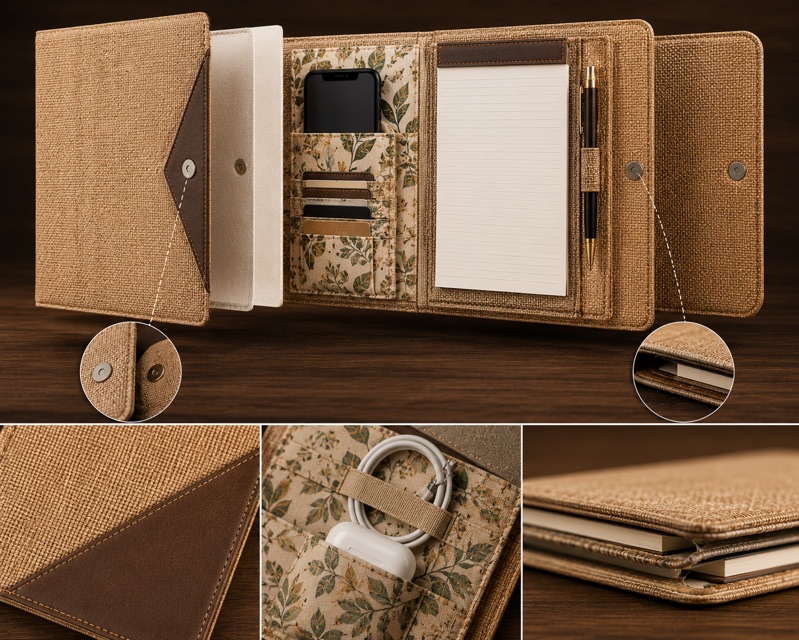
1. The Pre-Sustainability Era: The Reign of Plastic and Paper
To understand how far the jute folder has come, we must look at the environments it is actively replacing.
In the corporate expansion boom of the 1980s and 1990s, procurement strategies prioritized two metrics above all else: cost efficiency and uniform production. This focus led to a massive influx of petrochemical-derived file organizers. Polypropylene and vinyl folders became the baseline corporate standard because they were cheap, waterproof, and entirely utilitarian.
Parallel to this, fragile paper cardstocks filled archiving cabinets. However, as offices accelerated their operational pace, the short lifecycles of these materials became glaringly obvious. Paper folders frayed, tore, and demanded constant re-purchasing, while their plastic counterparts quietly accumulated in landfills, completely unequipped for a circular economy.
[ Conventional Evolution Timeline ]
Paper Archive Files (Fragile) ➔ Polypropylene Sleeves (Polluting) ➔ Modern Woven Jute Portfolios (Circular)
2. The Mid-2000s Shift: The Practical Eco-Alternative Emerges
As corporate social responsibility (CSR) departments transformed from optional public relations offices into core risk-management teams, procurement logs began facing strict audits. The initial response to reducing paper and plastic waste was a push toward the purely functional.
Jute entered the workplace during this period, initially valued for its undeniable raw durability. Derived from the rapid-growth Corchorus plant, early corporate iterations of jute folders were straightforward, rustic, and strictly functional. They were heavily utilized at eco-conscious trade shows and green seminars as a visible statement against the throwaway culture of plastic swag.
While these early versions proved that natural fibers could securely support heavy document stacks without tearing, they lacked the design refinement required to move from the convention floor into the executive boardroom.
Analyze Your Workspace Life Cycle. Are your current archiving and presentation materials contributing to a linear waste cycle? Contact our green procurement specialists to audit your office stationery footprint and transition to circular alternatives.
👉 [Schedule a Corporate Sustainability Review]
3. The Modern Era: The Rise of Eco-Luxury and Smart Organization
Today, the definition of a sustainable product has fundamentally matured. Modern design dictates that an eco-friendly tool must not ask a professional to compromise on style, aesthetics, or day-to-day utility. This philosophy has driven the contemporary refinement of the jute folder.
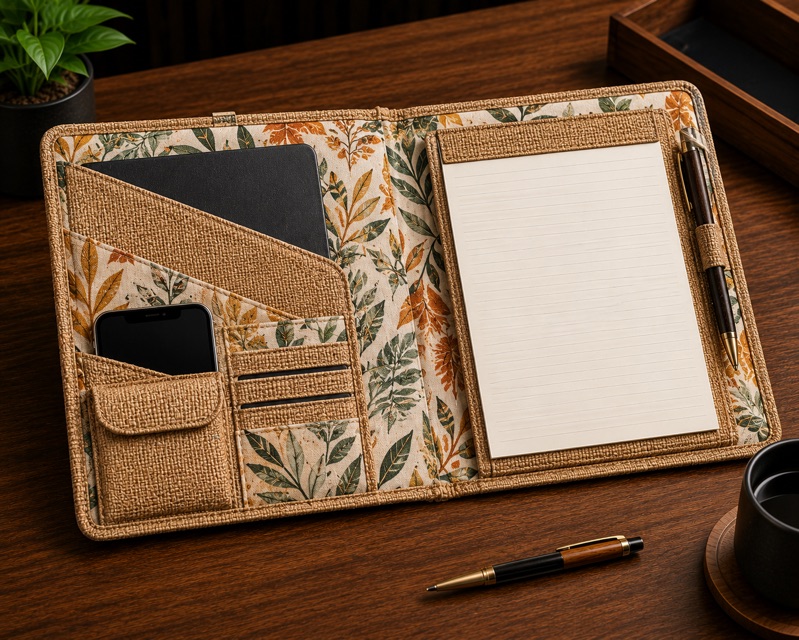
No longer just a simple woven pouch, the modern jute portfolio is a sophisticated piece of desktop engineering. High-end corporate variations integrate tailored structural elements designed specifically for the mobile professional:
Internal Multi-Utility Pockets: Specialized sleeves woven inside the folder hold tablets, digital styluses, business cards, and legal pads cleanly in place.
Aesthetic Branding Fusion: Advanced customization allows companies to seamlessly incorporate high-density embroidery, laser-engraved wooden hardware accents, and screen printing with non-toxic water-based inks directly onto the textile.
Ergonomic Closures: Secure magnetic snaps, recycled metal zippers, and organic cotton loops have replaced the clumsy plastic cords of the past.
By pairing the rugged, textured resilience of the "Golden Fiber" with clean, minimalist lines, industrial designers have successfully repositioned jute as a premium, texturally rich material that commands respect during high-stakes corporate pitches and board meetings.
4. Driving the Future: ESG, Carbon Capture, and Circularity
The modern adoption of jute folders isn't merely an aesthetic trend; it is anchored in hard environmental metrics.
In an era where international organizations are judged on strict Environmental, Social, and Governance (ESG) performance indexes, every single purchasing decision matters. Because a single hectare of growing jute plants sequesters approximately 15 tons of carbon dioxide in just a single season, substituting petrochemical folders with jute actively shifts a company’s operational ledger toward carbon negativity.
Furthermore, at the end of its multi-year operational life, the modern jute file leaves behind no microplastics or chemical residue. It degrades naturally back into the soil within months, offering a clean, completely circular end-of-life cycle that paper and plastic can never replicate.


0 Comments